By Rodolfo Elías
It was 60 years ago this month the night that changed music forever. The Beatles appearance on the Ed Sullivan Show, on February 9, 1964, as a turning point in the lives of thousands of kids around the world, who started envisioning a different future to the one envisioned for them by their parents; it wouldn’t be the same anymore. And it created a new paradigm in modern music, similar to what Elvis had accomplished eight years earlier, which was on the decline by then. That fateful Sunday evening, the world was witnessing the reinvention of rock ‘n’ roll and music was headed in a new direction.

On the weeks leading to the appearance of the Fab Four on the show, the anticipation had built up to a boiling point, reaching its climax on the longed-for evening. After Ed Sullivan’s introduction of the band, four smiling and fresh-looking youngsters appeared on TV screens all over the nation, with an aura of self-confidence about them. With their instruments, they played five songs they had composed themselves, with the exception of one. And Beatlemania was in full swing.
Behind were the days of Hamburg and prellies (the stimulant drug Prelludin), which they took in order to keep themselves going, through the long hours of music they had to play in those German clubs populated by drunk, bellicose sailors. But it was also in Hamburg where they earned their chops that made them the most solid, compact and distinctive band in the Merseybeat scene.
It hadn’t been easy, though, as the Beatles had already tasted rejection in a disheartening way. After their infamous audition with Decca Records they were turned down, in a not-very-nice way. Brian Epstein was told by one of the executives that he didn’t like their sound, just to add, “guitar groups are on the way out.” According to Epstein’s autobiography, “A Cellarful of Noise” (1964), he replied: “These boys are going to explode. I am completely confident that one day they will be bigger than Elvis Presley.” And well, it happened.
It’s quite an experience to see these boys on the stage with such a display of confidence. The songs that they played give us an insight —so early into the game— on their vocal prowess and originality. All they needed that night was five songs to conquer America and the world. Before the Beatles, most performers were getting their songs and music from commissioned musical teams. That’s how songwriting teams like Leiber-Stoller, Goffin-King and Holland-Dozier-Holland made a name for themselves. And the musicians who were behind most of the popular music that was being played on the radio was the Wrecking Crew, a group of professional session musicians based in Los Angeles.
Here’s Ed Sullivan introduction: “Now, yesterday and today our theater’s been jammed with newspapermen and hundreds of photographers from all over the nation. And these veterans agreed with me that this city never has witnessed the excitement stirred by these youngsters from Liverpool, who call themselves The Beatles. Now, tonight you’re gonna twice be entertained by them. Right now and, again, in the second half of our show. Ladies and gentlemen: The Beatles! Let’s bring them on.”
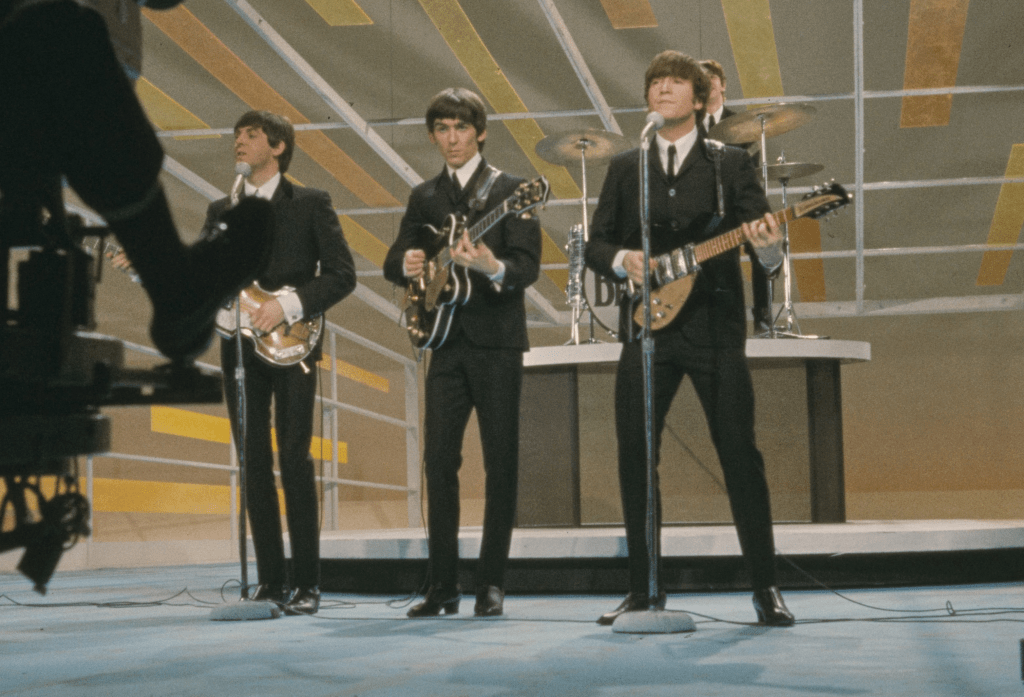
They started the set with “All My Loving”, a Lennon/McCartney piece. Although a completely ordinary love song, it feels like a game changer right off the bat: funny time changes, with extra beats and bars. And John’s rhythm guitar standing out dearly; he’s playing those triplets just the way mariachi band players do. This is what John said of the tune: “‘All My Loving’ is Paul, I regret to say. Ha-ha-ha. Because it’s a damn good piece of work. [Singing] ‘All my loving…’ But I play a pretty mean guitar in back.” The Beatles were no virtuosos, but they were already setting their own rules —which meant: no rules— to make music.
And they followed with “Till There was You”, by Meredith Wilson. I said before that a distinctive thing about the Beatles was the fact that they were passionate music listeners. And they grew up in the world of short wave radio, which provided them with a universe of choices that came from all different places across the Atlantic. One of those choices was a romantic Cuban style of music, called bolero, that was prominent in all the Spanish speaking countries. Mexico developed its own version of it, with bands composed of three musicians (guitars and rich, melodic vocal harmonies) called just like that: trios.
It is obvious that the Beatles were influenced by that kind of music; hence their own version of “Besame Mucho” (which was a bolero) and their rendition of “Till There was You”. The cadence with which Paul is singing and George’s guitar solo are out of this world. In other words, they made something very different of it. There are other two songs that were made in this style, both by Paul: “And I Love Her” and “I Will”.
“She Loves You” is the third song. An upbeat tune of conquered love that with any other band —that is not the Beatles— would sound like ordinary bubblegum. But the Fab Four infused it with their special touch; and the “Yeah, yeah, yeahs” and “woos” that became their trademark. They were using the arsenal of musical influences they had. “I thought it was great but was intrigued by the final chord, an odd sort of major sixth, with George doing the sixth and John and Paul the third and fifths, like a Glenn Miller arrangement,” is what George Martin said of “She Loves You”.
Then, the show went to commercials. And after covering different other segments, the mop tops closed the one-hour broadcast with two more songs, one of which was “I Saw Her Standing There”. This was one of the very first tunes that they wrote. At this early point in their career, their full acquaintance with rock ‘n’ roll music’s ethos is remarkable. They knew what rock ‘n’ roll stood for at it’s inception, and they helped it evolve progressively into more sensible forms and expressions. “I Saw Her Standing There” has a place among the most representative songs in rock ‘n’ roll.
Ten years later, John would appear on stage at one of Elton John’s concerts and they did this number together. Ironic how “I Saw Her Standing There” would be part of John’s first and last major live performances. One of many ironies in John Lennon’s life.
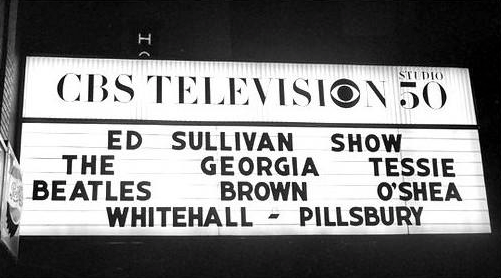
Finally, comes the song with which the Beatles’ conquest of America is associated with the most: “I Want to Hold Your Hand”. When we listen to this piece we think of success; we think of fame; we think of Beatlemania; and, finally, we think of pure love. As if they were singing the tune to each other, in regards to their friendship. John Lennon would reminisce years later about the process of composing it: “I remember when we got the chord that made the song. We were in Jane Asher’s house, downstairs in the cellar playing on the piano at the same time. And we had, ‘Oh you-u-u… got that something…’ And Paul hits this chord and I turn to him and say, ‘That’s it!’ I said, ‘Do that again!’ In those days, we really used to absolutely write like that —both playing into each other’s nose.”
For his Concert for Bangladesh, George recruited Bob Dylan, among some other well-known musicians. And, according to Rolling Stone magazine, “Harrison asked Dylan to perform ‘Blowin’ in the Wind,’ a song he hadn’t played in seven years. Dylan snapped back, ‘Are you going to play ‘I Want to Hold Your Hand?’” George didn’t take long to reply that it wasn’t his song. And he got what he wanted from Dylan.
Now, I don’t think I need to emphasize the fact that with this short setlist the Beatles were already showing a lot of promise; and it’s foolish to think otherwise. What they were doing was different to what everybody else was doing; different to everything else that was out there. And the people that started bashing them and finding fault with them, where out of point from the outset.
I am heavy metal generation. And one way of showing that we were down with it and sold out to the cause, was by bashing the Beatles. Just because they were commercial and sang “I Want to Hold Your Hand”. And because, according to bashers, “they sucked as musicians.” Some of them outgrew that attitude and eventually were able to recognize the real value of the Beatles music. But others have persisted in their foolishness.
As a youngster, I knew a guy who was a diehard metalhead. He listened to all kinds of metal (heavy metal, speed metal, trash metal, etc.). He is a conservatory musician and plays now classical guitar. And after all this time he hasn’t gotten over his dislike for the Beatles. He still thinks of them as the mop tops that appeared on Ed Sullivan, playing “I Want to Hold Your Hand” and “She Loves You”. But he also thinks that the only good guitar players in rock music are metal guitarists, because they play fast.
Before the Beatles appearance on the Ed Sullivan Show, rock ‘n’ roll didn’t seem to have much future, as it had reached a point where it got stagnant and didn’t seem to be going nowhere. It seemed to be fading away, mainly because it had lost it’s state of novelty. Crazes and fads had come and gone, and nothing really interesting was happening anymore. But here were four lads from Liverpool, to save the day.
 Revolver Beatles Channel