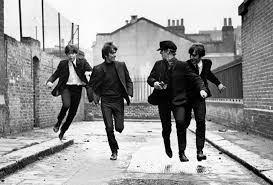
One single chord, from George’s Rickenbacker 360/12, opens the song; and the movie, too. That chord was opening the door for popular music and pop culture into a whole universe of new possibilities. It’s been a hard day’s night/And I’ve been working like a dog/It’s been a hard day’s night/I should be sleeping like a log, sings John Lennon with his nasal voice. In the movie, the opening scene cuts in from blackness and we see the four boys running down the street toward the camera, with a stampede of adoring fans behind them.

1964 was the year when the Beatles consolidated their status as the Fab Four, with two major milestones: the conquest of America —and, therefore, the world— and the shooting of their first and ultimate movie. Because, when we say a movie, we’re not talking about just any movie. For A Hard Day’s Night was a real artistic achievement musically, cinematographically and culturally.
The initial premise was to make a movie to accompany the record. And the main priority would be the music, as the mop tops were already showing their potential as a real hit-making machine. In September of 1963, when United Artists started talking about making a movie, the Beatles were a sensation in England; but it was as far as their stardom had reached at the time: a British phenomenon. In November, the screenwriter, fellow Liverpudlian Alun Owen, was recruited to work on the screenplay, which he finished in January of 1964. That was even before their first visit to America.
The opening scene in the film, along with the opening chord of the song, gave us a lot on the outset. In that scene the boys were running for their safety and they didn’t seem terrified or distressed —at all— but amused; that’s priceless. George trips and falls down with Ringo falling behind him. John turns to look at them and he keeps running, as they get up in no-time and start running again. If the previous two seconds hadn’t said enough already, this was the confirmation that A Hard Day’s Night wasn’t just another musical film. Of course, all that would have amounted to nothing if the rest of the film wouldn’t have lived up to that breaking scene; a feat that at one point might have seemed unachievable.
The stakes were high, so United Artists had a first class team working on the production of the film. But it was the boys, ultimately, who had to deliver the goods. “All the ingenuity might have been to little avail, however, had not the stars themselves proven their charisma fully transferable to the silver screen,” said Beatles biographer, Nicholas Schaffner.
And there was something about the four lads from Liverpool that went beyond their music, which got people to like them instantly. This is what the director Richard Lester said about it: “If you ask most people or you look up what was said about the Beatles in the early sixties, it was the word ‘freshness’. They had a quality that was unexpected. You didn’t take your eyes off them, because you never knew at what moment they would do something unexpected.” Quite on point.
Let’s not forget that at their initial contact with George Martin, it was actually their personalities and their charisma —not their music— that got him to want to work with them. And just like their personalities, their songs, and their music, their acting proved to be so natural and disaffected; imperfect to a point of perfection. Everything they did, they did it with such grace and naturality.
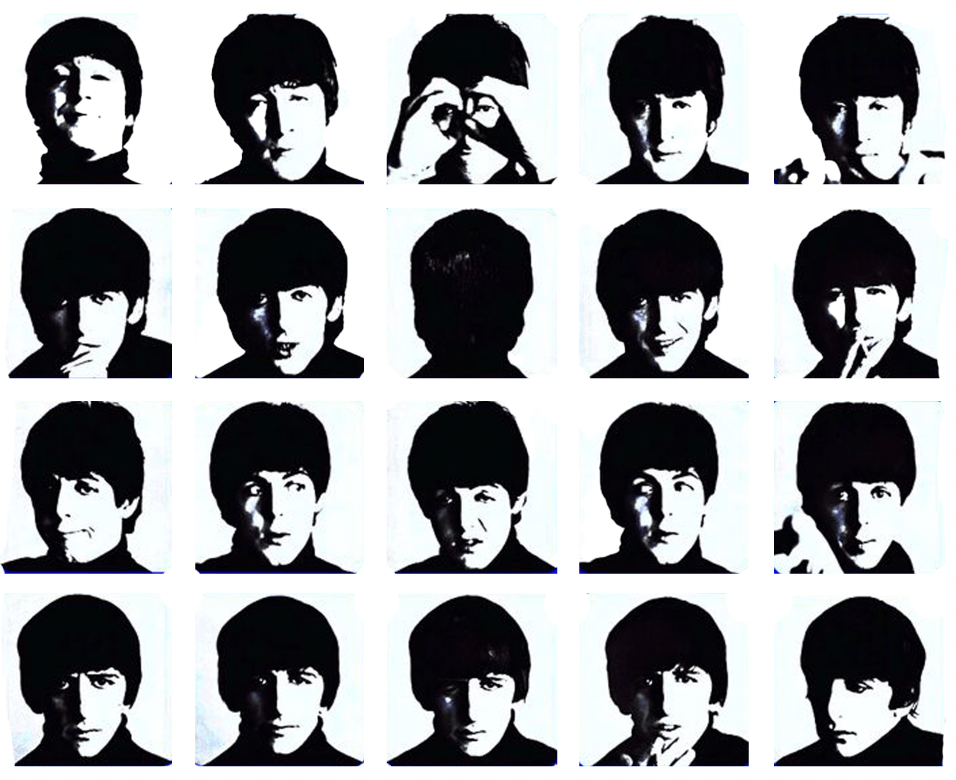
The acting was a tour de force, spontaneous and disaffected. Especially George’s acting, which was so natural and understated. His sardonic wit and the way he carried on with the dialogues, with that Liverpudlian accent; I mean, his whole demeanor. That scene where he’s shaving the man’s reflection on the mirror, with the shaving cream and the razor, is insane. “Put your tongue away, looks disgusting hanging out all pink and naked.” The Liverpudlian straightforward way of coming across. Richard Lester, on the so-called quiet Beatle: “George, I think, was the most effective actor all the way through, in that he attempted less. But he always hit it right in the center. And I always knew what I was going to get with George.”
And, John? Well, we were always anticipating a scene with John. Because he kept us on our toes, being so inappropriate with almost everybody he ran into, to the point of sick hilariousness. But it was part of the charm. With that air of mischievous innocence that he extended to his interactions outside of the movie set. Although there was a script, the boys couldn’t keep from doing their own thing. There were twelve ad libs or so in the movie, and John was the one who ad libbed the most. That scene in the bathtub —that ran along with George’s— was anthological.
According to Peter Brown, in The Love You Make (a Beatles biography co-written with Steven Gaines), at the end of the first day of shooting Pattie Boyd asked each Beatle to sign some autographs for her younger sisters, Jenny and Paula, “save for John, who frightened her with his sarcasm.” Which confirms that the John we see in the movie, is the John of real life. When they asked Richard Lester about working with John, he said: “John was not known to suffer fools. And I think I probably fell into the fool category. He was always willing to skew the pomposity around him. And I think there can’t be any more pompous person on a set than the director. So, I have wounds. But I have a huge, huge admiration for John. I think I can take all his criticisms that they were meant in the best possible taste.”
Richard Lester was an American filmmaker who made a career in England. And, as part of his credentials that won him the Beatles approval was his relation to The Goon Show, which he took to TV with a different name. John always talked about The Goon Show as a major influence in his personality and sense of humor. “I spent a lot of time with John and I was never less than impressed. And he was one of the three or four people in my life that have shaped me,” is what Lester said about John as a person.
In his treatment of A Hard Day’s Night, the director was original and creative, with that touch of surrealism that gave freshness and —oddly enough— more credibility to the film in the depiction of the boys’ daily life occurrences. In his approach, Lester proved to be insightful, articulate and honest; zero posing and zero phoniness. He shared, some twenty years later, that he’d been called the father of MTV, and that he had jokingly replied by asking for a paternity test.
But the distributors in New York still had their doubts and concerns about the Beatles phenomenon, as they feared it was just another craze that would subside in time. So, they told producer Walter Shenson that they had to ask him “a very important question.” The question was: Will the Beatles last? The distributors were thinking about putting out as many prints of the movie as possible, because they wanted to get their money back, “before the Beatles fade away.” And, although he probably wasn’t one hundred percent sure about it, the producer’s reply to the distributors was reassuring enough.
The title (for the movie and for a title song), however, wasn’t thought of until the end. According to Walter Shenson, he approached John toward the end of the shooting, asking him for a movie title. John thought of one of Ringo’s malapropisms, which Ringo had used to refer to a night after a long day in the recording studio.
Shenson also wanted a title song, and John asked about the sequence the song would be played on. So Shenson described the opening scenes of the movie and asked John for a “nice, fast song.” When John asked what the lyrics were supposed to be about, Shenson replied: “John, you’re the lyricist. You’re the writer; I’m not. [Something like] ‘A hard day’s night till I come home to you’.” Next day, John and Paul summoned Shenson in their dressing room and played the song to him; on such short notice. It was a hit.
One thing that we also have to acknowledge about A Hard Day’s Night is the script. A screenplay that was so well crafted and so natural in the development of the plot’s dynamics that you feel everything the Beatles did, every scene and every dialogue, was all ad libbed, freewheeling. “The script turned out to be arguably the best cinematic representation of Swinging London, along with Blow Up and Alfie,” says Peter Brown in his book.
When they commissioned Alun Owen to write the script, all they told him was that it was going to be about a day in the life of the Beatles. So he spent a normal day with them. “We went from the hotel straight to a press reception, straight to the theater, and at no time were they actually allowed to enjoy what was supposed to be success,” Owen shared. And as part of the report he gave to Walter Shenson, Owen said that the Beatles were prisoners of their own success. “There’s a price to pay for that sort of success. You see them running from place to place, doing things and things; but at the same time being impelled. And the only freedom they actually get is when they start to play the music. And then their faces light up, and they’re happy. But mostly they are confined.”
But the Beatles functioned as a unit from the very beginning, as a real brotherhood comprised of the four lads (and don’t forget Neil Aspinall and Mal Evans), with Brian Epstein as a sort of father figure. That’s what kept them grounded and also what made them so unique as a team, until the end.
As time went by, they were judged severely (especially John and George) by some critics and naysayers, because of their “meanness” and lack of niceness toward the fans. Nobody seems to think of the fact that the Beatles were victims of unaddressed PTSD. We have to remember that there has never been anything like Beatlemania; even Elvis’ phenomenon wasn’t close to that. The Beatles were pioneers in everything they did and, therefore, had to endure a lot. And there were two main incidents in their career as a band that left them scarred forever: what they experienced with Imelda Marcos in Philippines and going through their last tour, as a consequence of the backlash they faced after John’s declaration that the Beatles were more popular than Jesus.
A Hard Day’s Night was a commercial and artistic success. People filled up movie theaters around the world the same way they would fill up venues at their concerts and live shows. The fans and sympathizers saw the movie as a way to spend some time with the Fab Four and experience Beatlemania from the inside; and to witness what was like to be a Beatle. Other people attended just to verify that the Beatles were just a creation of a good marketing apparatus, but they walked in to a big surprise.
The critics were flabbergasted. “So help me. I resisted the Beatles as long as I could,” declared
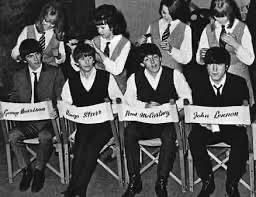
Andrew Sarris, the Village Voice film critic. “My critical theories and preconceptions are all shook up, and I am profoundly grateful to the Beatles for such a pleasurable softening of hardening arteries.” He called it the “Citizen Kane of jukebox musicals.” To which Roger Ebert agreed: “It’s actually a pretty good statement by Sarris, because it does liberate the jukebox movie, whatever that is, in the same way that Citizen Kane liberated the feature film. The Frankie Avalon movies, the Elvis movies, the Pat Boone movies… they were all pretty dumb and pretty insipid. And A Hard Day’s Night does not condescend to its audience.”
“The legitimacy of the Beatles phenomenon is finally inescapable,” said Newsweek magazine. “With all the ill will in the world, one sits there, watching and listening —and feels one’s intelligence dissolving in a pool of approbation. Even Ringo’s rings become tokens of something which is somehow important and delightful.”
But the mop heads were impacting and influencing the world in different ways. In an interview, Byrds’ Roger McGuinn shared, “We saw A Hard Day’s Night and realized the Beatles were playing a Gretsch electric six-string, Ludwig drums and a Hofner bass. And George Harrison switched between the Gretsch and this Rickenbacker 12-string that didn’t look like a 12-string at first, because the peghead concealed six of the tuners. But when he turned sideways, I went, ‘Oh that’s a 12-string!’ I was playing a Gibson acoustic 12 with a pickup in it, but it didn’t have the kind of sound George was getting. I liked his sound better, so I went out and got a Rickenbacker 360 12-string.”
A year later, the Beatles would have an even greater influence on McGuinn, when they released Rubber Soul, the album that prompted the Byrds to take a more ambitious approach to music and the development of a style that would define their career: folk-rock. This is what he said about it: “There’s controversy [about] who started folk-rock. Was it Eric Burdon and the Animals, with ‘House of the Rising Sun’, because they were doing a Dylan version of a folk song? I don’t know. I’d say the Beatles started folk-rock, because they’re the ones who inspired me to put folk music and rock and roll together. They were already doing it, subconsciously. They were playing folk rock, but they didn’t know it.”
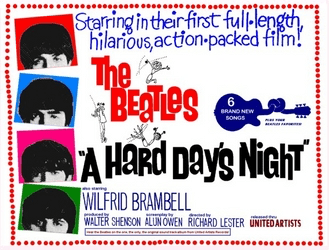
And we have A Hard Day’s Night, the album, which was also a big happening. It showed the evolution of the Beatles as artists, as they kept perfecting their craft. From simple rock ‘n’ roll and pop tunes, they started evolving to a harder sound and more direct, pointed lyrics. There’s still some bubblegum in the record, but the approach to pop music is changing overall. Five tunes stand out dearly along these lines: the title track; the Mexican-bolero- influenced ballad And I Love Her, which was the third one on this style; the rockers Can’t By Me Love and You Can’t Do That; and the sophisticated Things We Said Today. Sadly, although they recorded it live in the theatre, You Can’t do That was left out of the movie. They must have had their reasons for that.
A Hard Day’s Night was released on July 6, 1964, and was an unexpected achievement that has withstood the test of time, after 60 years of its release. When you watch it, it still puts a smile on your face and it gives you a break from the cares of this troubled, modern world. We owe it to the Beatles and we owe it to the people that made it possible. “The entire creative input as to what this movie should be and how to maximize the talents of this extraordinary group of young men came from Dick Lester, Alun Owen, and Walter Shanson.” David Picker, VP Production & Marketing, United Artists.
By Rodolfo Elías.
 Revolver Beatles Channel